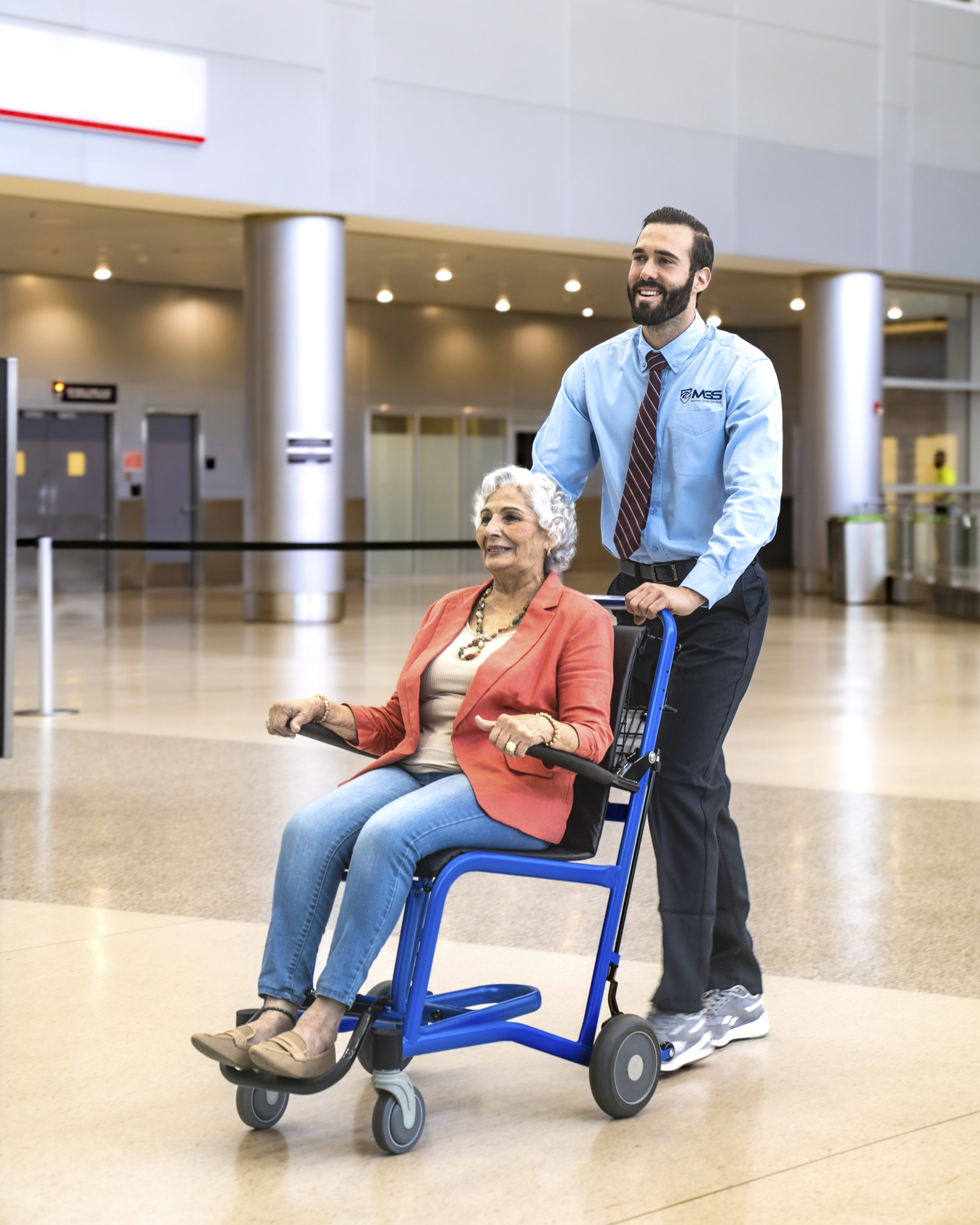
At MGS, technology isn’t “the IT guy.” It’s an enabler. We integrate practical tools—heat mapping, telematics, and shared dashboards—to make airport operations faster, safer, and more personal. These tools show up every day on the ramp and in the terminal, supporting our teams and elevating the experience for passengers and airline partners alike.
Tech ≠ IT: Why We Build for People, Not Screens
Airlines hire partners to reduce chaos, not to add dashboards for the sake of dashboards. Our philosophy is simple: technology should make real work easier for agents and station managers, which should deliver a better passenger experience. That mindset guides every decision we make about the tools we build or buy.
What that looks like in practice:
- Tools chosen for age- and task-appropriateness. Sometimes the smartest solution isn’t a high-tech one. For example, a curbside assistance button or intercom can be far more effective than a smartphone app for travelers with mobility challenges. By focusing on accessibility, we make sure our tools serve everyone.
- Middleware integrations rather than a monolith. Instead of building one massive platform that forces everyone to adapt, we use a modular architecture built on middleware and microservices—connectors that let existing systems talk to each other. This approach keeps data flowing where it needs to go (between dispatch, operations, and our airline partners) without adding new layers of complexity.
- Bidirectional visibility with airline partners. Transparency is key. We believe both MGS and our airline partners should have access to the same operational data, so decisions are made from a shared understanding of what’s actually happening on the ground. That shared visibility builds trust and helps us work together to anticipate challenges before they become disruptions.
Together, these principles keep technology in its proper role: empowering people rather than distracting them.
Multi-Channel PRM Requests That Actually Work From Curb to Gate
Passengers who need assistance shouldn’t be told to “go over there.” That kind of fragmented experience is exactly what MGS set out to fix. Our multi-channel intake system (we call the assistant Mira) meets passengers where they are and routes help efficiently to where it’s needed. Here’s how it works:
- Curbside podium/intercom or quick call: The request is captured immediately, ensuring travelers aren’t left waiting or wandering to find help.
- Agent handoff: If a passenger speaks with an airline representative instead of directly contacting MGS, that request is automatically converted into a structured digital task in our system.
- Intake → API routing: Each request becomes a job with a clear SLA, assigned ownership, and built-in tracking so supervisors can see the full picture in real time.
The result is simple but powerful—first contact happens faster, handoffs are fewer, and documentation is clearer. Airlines get stronger compliance records and better visibility. Agents get fewer frantic calls, and passengers get a smoother, more dignified experience (if this sounds like a fit for you, request an assessment).
Routing, Staging, and Close-the-Loop Proof
Once a passenger’s request comes in, MGS technology does what human intuition alone can’t: it instantly matches the need to the right team, sets time targets, and tracks every milestone until completion. Supervisors can see live status updates from their dashboards, giving them the awareness to step in early if something slips.
This is happening in real time across terminals. Every request is logged, assigned, and monitored through a clear sequence of checkpoints that mirror the passenger’s journey.
Typical PRM journey checkpoints:
- Assignment: within minutes of request, the task is routed to an available agent.
- Pre-arrival staging: the assigned team arrives at the gate before the plane lands, ensuring readiness and minimizing wait time.
- Transfer & escort: every major handoff—from aircraft door to wheelchair to baggage—is logged as a milestone for accountability.
- Baggage / curb: completion is captured automatically for audit and quality assurance.
What this accomplishes:
- Compliance clarity for DOT and TSA-related procedures, backed by verifiable timestamps rather than assumptions or manual logs.
- Consistent service and fewer errors across shifts, airports, and peak windows—because every team is following the same digital playbook.
- A true “closed loop” process, where the outcome is tied to data, not just checkboxes. When something goes right, we can prove it. When something goes wrong, we can see exactly where and why.
By translating every step of the PRM process into measurable actions, we turn what used to be anecdotal into actionable insight and make it easier for airlines to trust the numbers as much as the service itself.
The 3 Views That Tell the Whole Story
A single KPI rarely tells you why something happened. At MGS, we designed our dashboards to show not just what occurred, but how and why. Three connected views help leaders see the complete picture so they can make informed decisions.
- Employee Performance: Work volumes, pace, quality checks, and a composite performance score (built from multiple variables) help us coach and staff intelligently.
- Station/Airport Outcomes: Trending of incident categories and compliance signals at the station level so we can spot patterns and fix root causes quickly.
- Customer Journey Milestones: The high-level flow for passengers (assignment → arrival → transfer → completion) with time deltas for each leg.
The result? A clear, traceable line from how teams worked → what happened at the station → what the traveler experienced. It’s the kind of transparency that not only builds confidence with our airline partners but continuously raises the bar inside MGS, too.
How Heat-Mapping & Telematics Put People Where Passengers Need Them
Airports are dynamic environments where conditions change minute to minute. Through heat-mapping, MGS can see how passengers move through terminals and where assistance is most frequently needed. Telematics adds the next layer by showing where employees and assets actually are in real time.
When we combine those insights, station leaders can make smarter decisions about staging and staffing. Teams are positioned closer to demand rather than defaulting to central posts. Response times shrink, particularly during peak travel windows or irregular operations. And because our planning is based on real movement data instead of guesswork, each station can fine-tune schedules to match its unique flow.
This is how data becomes practical: not a report after the fact, but live information that helps us serve passengers better in the moment.
Asset Tracking is Customer Experience (and Risk Management)
A wheelchair left at the curb is an obvious inconveniencem but it’s also (more importantly) an operational failure that costs time, money, and trust. By embedding telemetry into essential equipment like wheelchairs and carts, MGS can monitor asset location and usage instantly. That visibility allows us to:
- Redeploy equipment quickly, keeping service uninterrupted.
- Maintain tidier, safer terminals that reflect well on the airlines we serve.
- Ensure compliance and billing accuracy with clear movement logs.
When assets are treated as extensions of the service experience, efficiency and passenger satisfaction rise together.
Transparency First: Shared Data Helps Make Better Decisions
Our technology is only as valuable as the trust it builds. That’s why we share the same dashboards and metrics with airline partners that our internal teams use. As an ISO 9001–certified organization, MGS audits performance year-round to ensure our digital systems and operational processes meet the highest quality standards. With everyone looking at the same data in real time, communication stays collaborative, not corrective.
If flight volume drops, we right-size staffing together. If traffic surges, we respond in sync. The goal is to operate in total transparency so we can all optimize performance as a unified team. That’s what partnership looks like in practice.
What does this mean for airlines? Glad you asked:
- Fewer handoffs, faster help → better passenger sentiment
- Documented compliance → fewer surprises, cleaner audits
- Smarter staffing & staging → efficiency without guesswork
- Shared truth in dashboards → decisions you can defend
Technology at MGS is about giving people the right tools to do their jobs better. When employees have real-time visibility, passengers get faster service, airlines get cleaner data, and station managers gain control instead of chaos.
Every system we build, from live heat-mapping to asset tracking, supports the same goal: a seamless, safe, and human-centered airport experience. That’s the difference between a vendor that uses technology and a partner that builds it around people. At MGS, the tools may be digital, but the results are unmistakably human.
If you’d like to see how MGS’s technology can simplify your station’s day-to-day operations, request a custom assessment. We’ll map intake points, staging zones, and dashboards to your unique layout and passenger flow—so you can see firsthand how our people-first tech delivers measurable results.